|
:: EDITORIAL & ANALYSIS ::
From The Temple Of Doom to Footballer's Wives Hindu Voice UK, July 2006
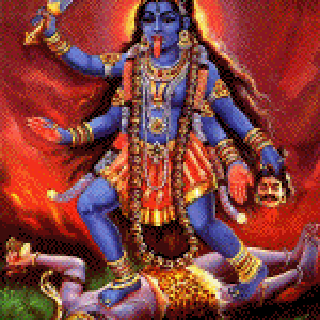
It hadn't occurred to me till then how films like these can have a lasting effect in moulding the views of people that watched them. I tried to correct my friends, explaining the philosophy underlying the concept of Mother Kali. A girl replied; "If Kali is a great Mother Goddess and venerated by millions of Hindus all over the world then why is she always shown as an evil blood thirsty demoness in all these films? Surely this image must have come from somewhere."
"It was the kind of Fascist film you could see before WWII" So said the film's producer George Stevens later in his career. However in the case of Hindus and especially in case of the much maligned Goddess Kali you can still make this kind of "Fascist" film, as was to be proven by Steven Spielberg with his Indiana Jones and Temple of Doom. Here again we come across Kali as a bloodthirsty demoness lusting after human flesh and worshipped by adoring throngs of entranced, arm-waving, dehumanized followers, this time led by priest Mola Ram. In the narrative there are lines like "Mola Ram. Prepare to meet Kali... in Hell!" The only thing that had changed in the fifty odd years between the two films is that while a white actor - though brown-faced - featured in Gunga Din, a brown actor is used in Temple of Doom to retell the same old xenophobic rhubarb.
Films and TV programs like these are fraught with xenophobic imagery and misrepresentations reinforcing colonial notions of Hindus as uncivilised savages with brutal gods. It could be argued that Thugees were indeed a real group and thus as the dominant impression of Kali in western media as portrayed in these films is somehow justified. However history tells us that the Thugee were just a sort of back-country Mafia that slaughtered tradesmen and anyone traveling with valuables, and that their Kali worshipping religious element has just been romanticised to create fantasies about them. Research shows that they had both Hindus and Muslim as members and naturally tended to take up the general religious customs of the region they resided in. It could also be argued that films are normally based on popular notions and not necessarily entirely on historical evidences, and therefore there is nothing wrong with films like these. But the fact is that films in today's world are not simply induced by popular culture and prevalent notions, but they themselves exert influence and alter popular notions. In fact films are capable of forcing viewers into a position that defies serious analysis, and if well made the viewer will surrender his or her self to ideas perpetuated at some point during the narrative. That is why Holocaust history has often focused on the propaganda films and productions of Leni Riefenstahl for Hitler's genocidal missions. I wonder whether films in which Kali is portrayed in this way will eventually become the subject of similar studies? But more importantly it is not stereotypes themselves that are problematic per se, but the way certain groups are treated. In Schindler's List and Saving Private Ryan Spielberg has focused intently the accuracy and legitimacy of the image of Jews and veterans and the ravages of war. If popular but false negative stereotypes were really so dominant, one could easily expect a film involving stingy Jewish alchemists and wizards conjuring up Golems and secretly controlling the world with the help of a vengeful god. But while this type of callousness and disregard would not acceptable in the case of Jews, it is not only tolerated but also continuously exploited for entertainment value in case of Hindus. When films and television programs full of stereotypic depictions of a community or culture are repeatedly churned out, historical facts and truths become obscure in the shadow of media perpetuated notions. So back
to my friend's original question: why in spite of being a deity venerated
by millions of Hindus is Kali is portrayed as a bloodthirsty demoness
in a range of western movies? The answer is a combination of ignorance
and xenophobic and cultural prejudices in regards to Hinduism, to
which education is the only antidote. |